
How to Turn Your Engineers Into Your Best Marketing Asset

Ask most industrial companies who their best marketing asset is and they’ll usually point to their website, their brochures, or maybe a marketing hire they brought on last year. Almost none of them will point to the person sitting in the design office who’s spent fifteen years solving the exact problems their buyers are trying to solve right now.
That’s a mistake — and it’s becoming a more expensive one.
Your engineers already know the answers to the questions your buyers are quietly typing into Google. Or, as we covered in our article on how B2B buyers are now using AI tools to shortlist suppliers, the questions they’re increasingly asking ChatGPT and similar tools. The knowledge already exists inside your company. It’s just never been written down.
This article is about how to actually fix that — in a practical way, without turning your best technical people into reluctant bloggers or eating hours they don’t have.
Why this matters more than most companies realize
Content Marketing Institute’s 2026 research on B2B content found that nearly every company now produces some form of thought leadership content — but only a small share of them do it well. The single biggest predictor of a weak program, according to that research, is low participation from the people who actually hold the expertise. In more than a third of companies surveyed, less than 5% of employees with real specialized knowledge are ever asked to contribute to content at all.
Almost every company is trying to do thought leadership. Almost none of them are actually using their most knowledgeable people to do it. That gap is exactly where an opportunity sits for a company willing to close it.
Buyers notice the difference. Research from Edelman found that a strong majority of B2B buyers say they trust companies with visible, credible thought leaders more than companies without them. Separate data cited by LinkedIn found that B2B marketers who invest seriously in thought leadership content see a significant increase in qualified leads compared to companies that rely only on standard promotional material.
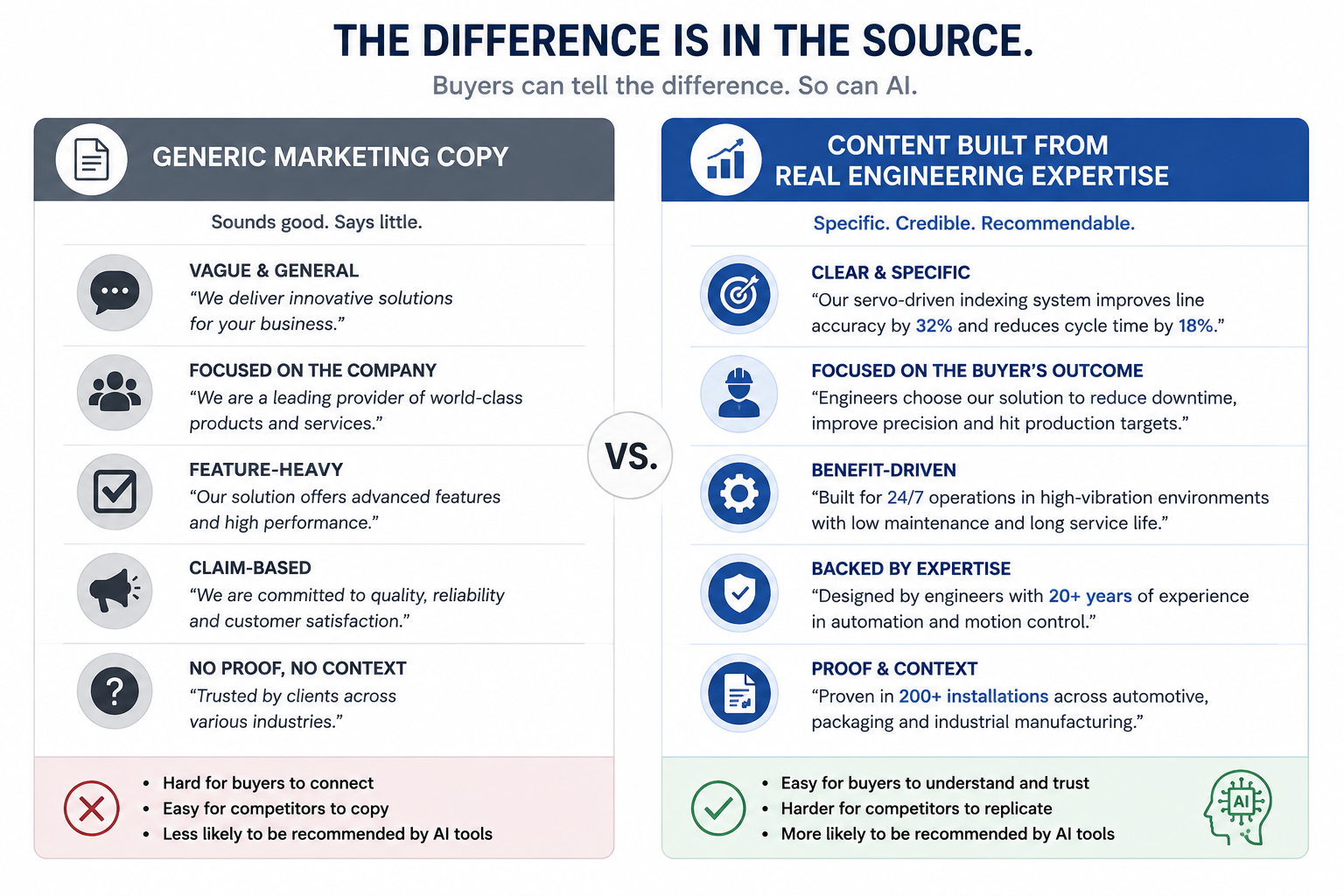
There’s a simple reason for this. A generic product page, written by someone who’s never actually worked with the equipment, reads like every other product page. An article written by (or built from a real conversation with) an engineer who’s actually solved the problem reads completely differently — specific, confident, and hard to fake. Buyers, and increasingly the AI tools summarizing content on their behalf, can tell the difference.
Why this matters more than most companies realize
If the value is this obvious, why doesn’t it happen on its own? In almost every company we’ve worked with, it comes down to three quiet, very human blockers — not a lack of knowledge, and not a lack of willingness.
Engineers don’t think what they know is interesting. Something an engineer has known for ten years feels completely obvious to them. It doesn’t occur to them that a buyer, or even a competitor’s engineer, would find it genuinely useful. The knowledge that feels most “basic” to your team is often exactly what a buyer is trying hard to figure out.
Nobody has time to sit down and write. Engineers are busy doing engineering work, not writing articles. Asking someone to “write a blog post” on top of their real job is asking for something that will always lose to more urgent priorities — and rightly so.
There’s no process, so it depends entirely on individual motivation. Without a repeatable system, content only gets made when one enthusiastic person happens to have spare time and the inclination to write. That’s not a strategy — it’s a coincidence, and it stops the moment that person gets busy or leaves.
None of these three problems are solved by asking harder or hoping someone volunteers. They’re solved by changing the process itself.
A practical way to actually do this
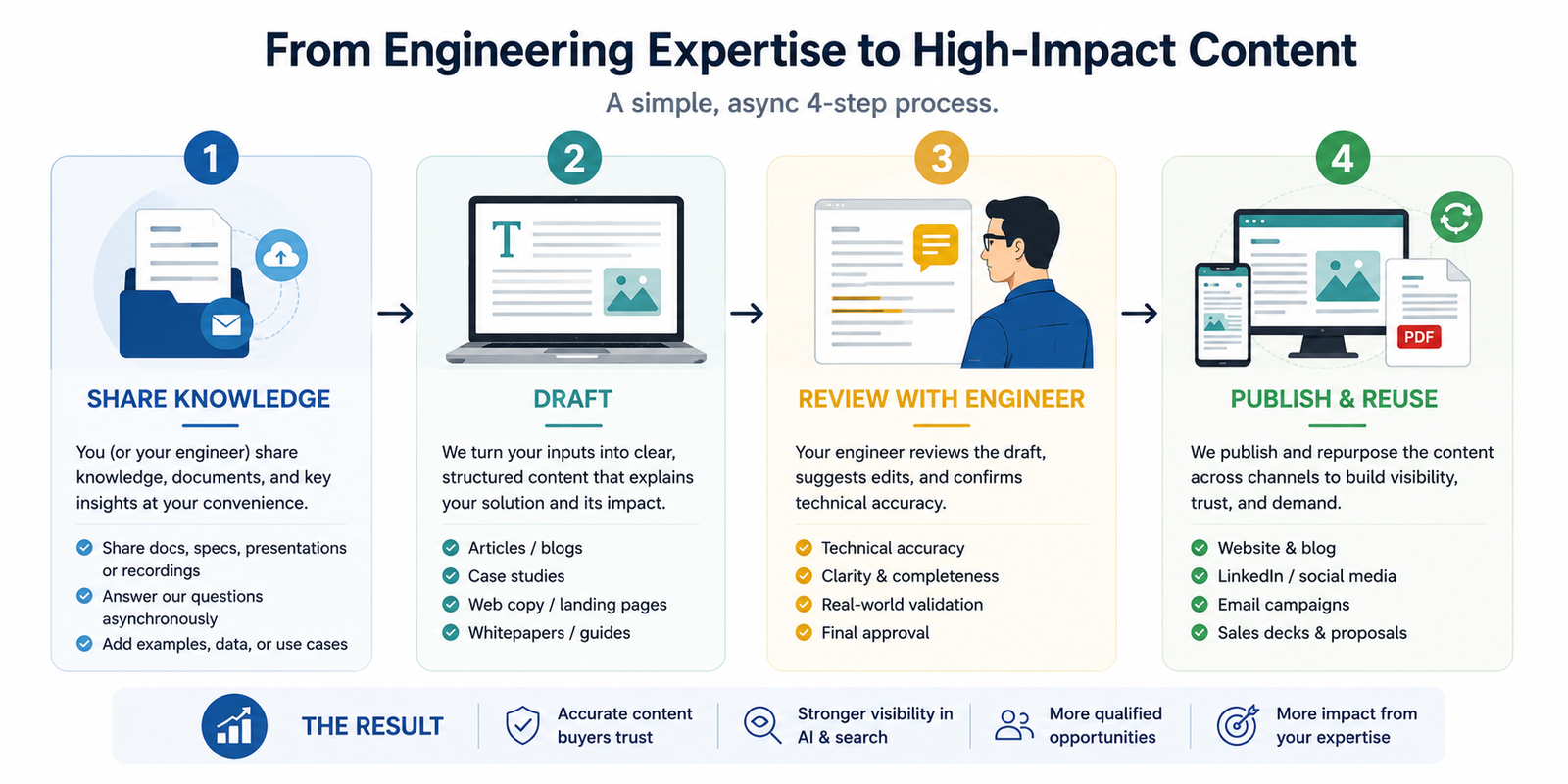
Interview, don’t assign writing. This is the single most important shift. Instead of asking an engineer to write an article — which most technical people genuinely dislike doing — have a short, structured conversation with them and build the article from that. A 30–45 minute conversation focused on a specific real problem they’ve solved produces far more usable material than asking someone to stare at a blank page. This is exactly how case studies and technical articles should be built, and it’s a core part of how we work with clients.
Start from real questions, not abstract topics. Don’t ask an engineer to write about “trends in automation.” Ask them: “What’s the most common mistake you see customers make when specifying a servo drive?” or “What’s a problem you solved last month that a competitor’s engineer probably couldn’t have?” Specific, real, recent questions produce specific, real, useful answers — and they’re far easier for someone to answer off the top of their head than an open-ended prompt.
Capture it once, reuse it many times. A single 40-minute interview can become a technical article, three or four LinkedIn posts, a case study, and even the raw material for a short explainer video. Most companies treat every piece of content as a separate project that starts from zero. The efficient approach is to extract as much as possible from a single conversation, then reshape it into different formats.
Give credit, visibly. Publish the article under the engineer’s name, or at least feature a photo and their title. This does two things: it gives them a genuine, low-effort win — most engineers quietly enjoy being recognized as an expert — and it makes the content far more credible to a buyer than an anonymous, unattributed page ever could be.
Build a small, repeatable rhythm. You don’t need a company-wide content program on day one. Start with one engineer, one conversation a month, one article. A steady trickle of genuinely good, expert-sourced content will outperform an ambitious plan that collapses after one enthusiastic sprint. Research from LinkedIn’s own content data backs this up — consistency over time matters more than short bursts of high output.
What this looks like in practice
Picture an application engineer at an electrical panel manufacturer who’s spent years fielding the same handful of questions from customers about arc flash protection. None of that knowledge has ever been written down anywhere public — it lives entirely in his head and in one-off email replies to customers who happen to ask.
A single 40-minute conversation with him — structured around real, specific questions rather than an open “tell me about arc flash protection” prompt — can become a genuinely useful technical article explaining what most buyers get wrong when specifying protection equipment. That same conversation can be reshaped into a few LinkedIn posts breaking down individual points. And if the company has worked on a project where this exact problem came up, it becomes the backbone of a real case study too.
None of that required the engineer to write a single word. It required someone to ask him the right questions, and then do the work of shaping his answers into something publishable.
Where this fits into a bigger picture
This kind of content doesn’t work in isolation. It works best as part of a connected system, where your website, your published articles, and your sales materials are all telling the same consistent story about what your company actually knows. That’s the whole logic behind our Growth Program: we start by figuring out exactly which stories and expertise inside your company are worth surfacing, then build the plan to get them out into the world properly.
If you’re not ready for an ongoing program yet, this is also exactly the kind of work we do as a standalone project — a single case study, or a small content pack built from a few conversations with your team, through our Project-Based Services.
Either way, the starting point is the same: figuring out who on your team actually has the knowledge worth sharing, and what they’ve been quietly solving for customers that nobody outside the company has ever heard about. That’s a conversation we’re always happy to have — it usually starts with understanding who we work with and where your business currently stands.
The bottom line
Your best marketing asset probably isn’t a person in a marketing role at all. It’s the engineer who’s already solved the exact problem your next buyer is trying to solve — the one who’s never been asked to talk about it publicly.
Fixing that doesn’t require turning technical people into writers. It requires a short conversation, a process to capture it properly, and the discipline to keep doing it consistently. Companies that figure this out now — while most competitors are still treating content as a marketing department’s problem alone — will have a real head start, especially as more buyer research shifts into places where genuine expertise, not polished marketing copy, is what actually gets noticed.
Let’s talk about which stories inside your company are worth telling.